

Listen here:
New technology from at the University of Missouri promises to provide real-time insights into the health and welfare of horses, even when they are turned out on pasture with their herdmates.
Drawing from his previous work on a blood pressure sensor for people, Morgan Miller, PhD—together with his supervisor Jian Lin, PhD’s research team—is developing a sensing system that can capture and transmit biometric and location data from horses in real time and from a distance.
Wearable device
The system centers on a wearable device that incorporates a photoplethysmography (PPG) sensor that measures heart rate, a GPS module for location tracking and an accelerometer and gyroscope for motion detection.
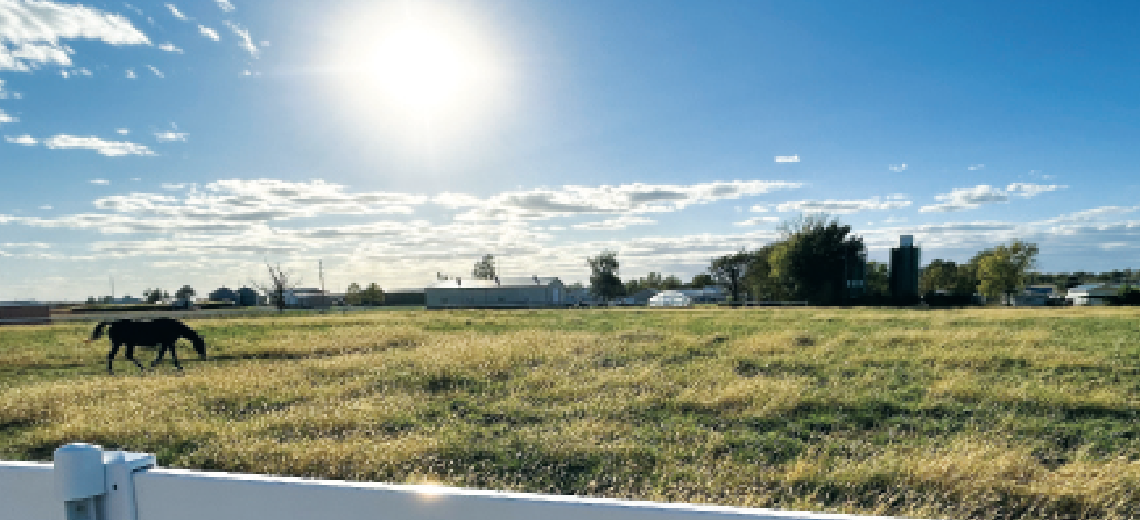
Researchers are developing a system that can transmit biometric and location data about horses in real time and from a distance. (Photo courtesy, Morgan Miller, PhD)
Attached to the base of a horse’s tail, the device connects to an “Internet of Things” (IoT) network that includes a cloud-based server that stores and disseminates collected data. This is the first such system developed specifically for use in horses.
Two phases of testing
Miller and his team tested the IoT system in two phases. In the first, eight horses wore devices while kept in stalls. The sensors trans-mitted data about heart rate continually for 15 minutes. For three times during the same period, researchers checked each horse’s heart rate using a stethoscope.
To validate the reliability of the sensors, the researchers determined heart rates manually then compared them to those reported through the IoT system. The researchers found that the sensors reported heart-rate information with 95 percent accuracy.
For the second phase of the study, six horses living wore the devices on six days while kept in the same field. On each day, the IoT system tracked each horse’s heart rate, location and activity. The researchers determined that the sensors had a maximum transmission distance (from horse to receiver) of 305 meters—the equivalent of more than three football fields.
Promising results
The researchers then reviewed the collected data, looking for correlations between locations in the field and periods of increased heart rate, a sign of stress.
“The goal really was to see if we can make informed decisions or suggestions as to what could be causing stress in their environments,” says Miller. “If they’re in X part of the field and we see elevated heart rates, we then go and look at that part of the field and try to understand what happened.”
Overall, the horses had elevated heart rates when they were in parts of the pasture that were near a busy service road, barns, feeding areas and other environmental stressors.
This underscores the potential to “improve animal welfare … by providing detailed insights into the effects of environmental factors on herd behavior,” the researchers wrote in their published study. “We envision the potential of advanced analytic tools, such as machine-learning algorithms, to extract hidden information from the collected data. This could enable the prediction of horses’ behaviors in different settings, preventing potential health risks.” For their next study, the Missouri team plans on using sensors to help detect signs of labor in mares.
In general, though, Miller just wants people to know their horses better. The goal of the system, he says, is “to try and help inform caregivers of what they can do differently in their pasture settings or things like that to try and better [horses’] lives.”—Eliza McGraw
Reference: “Networked wearable sensors for monitoring health and activities of an equine herd: An IoT approach to improve horse welfare,” IEEE Sensors Journal, September 2024