

QUESTION: My new horse has a small sarcoid (diagnosed by my veterinarian) on his neck. It’s a crusty lump, about the size of a dime, that I thought was a wart. He is 12 years old and I’m not sure how long he’s had it. My veterinarian said I didn’t have to do anything about it because it’s not near where tack sits. But I’m worried that it will just get larger and larger. Do sarcoids tend to grow? If I did decide I wanted to remove it, what are my options? I’ve heard that if you “upset” tumors without removing them, they get more aggressive.
ANSWER: Sarcoids can be tricky tumors for a couple reasons. They can sit quietly without causing a problem for a long period of time and then suddenly start growing. Also, even though they may appear small, they have what we call wide biologic margins. That means tumor cells under the skin surface can extend out widely beyond the main growth itself.
Excision
If the location of a tumor makes surgery an option, excision is typically considered the best option. The goal is to remove the entire tumor while it is small, along with a wide enough margin of tissue around it to encompass both visible tumor tissue and microscopic tumor cells.
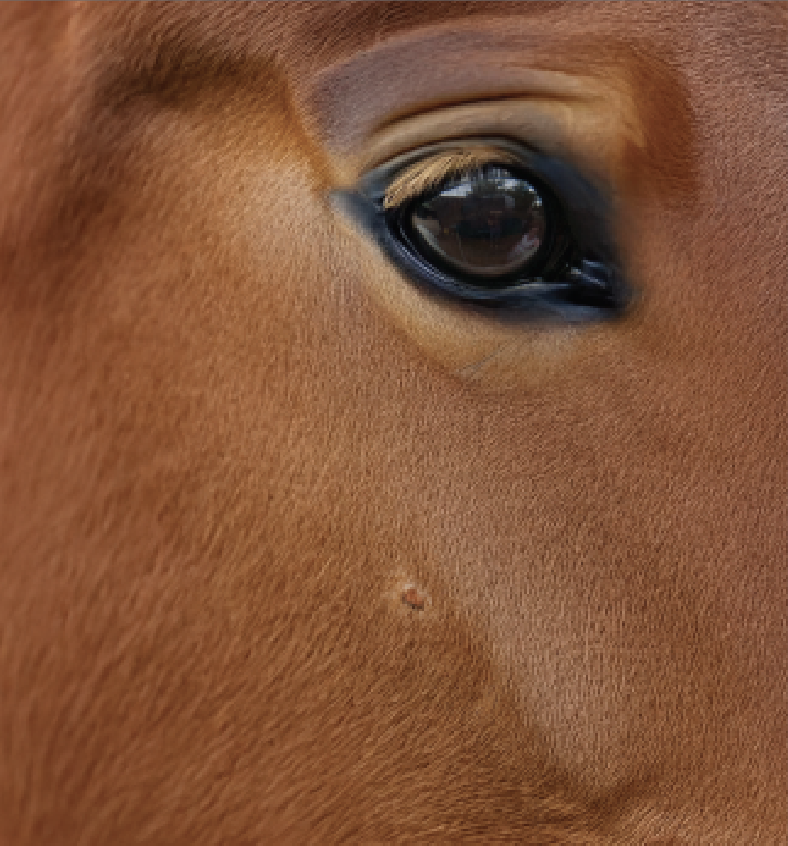
Usually we try to have “clean” surgical margins (without any tumor cells) of at least one inch. Sometimes we want wider margins, all the way around, which can be difficult to achieve, depending on the location of the tumor and how much skin tension and motion is present at the site. It is very important to submit the tumor to a laboratory after it is removed to confirm the tumor type. Sometimes other skin diseases can look like sarcoids and vice versa. Also the surgical margins must be assessed to see if additional treatment is needed. A biopsy can be done before surgery to identify the type of tumor, which in turn determines which types of treatment would be most effective.
If the sarcoid is small, superficial and in an area where surgery may be challenging, a topical treatment with an agent called imiquimod can be considered. Imiquimod stimulates the immune system, encouraging inflammatory cells to attack the tumor. This treatment can work well on thin or small tumors. But it is less likely to be effective with thick or bulky growths. Applying this drug to the right tumors is key to its success.
Topical and injectable medications
If the tumor is removed and the margins are too narrow, meaning there’s a risk that tumor cells remain, or residual tumor cells are left at the surgical edges, then another surgery to remove more tissue may be advisable. This a called a “recut” procedure. If a recut is not possible or if the tumor is in an area where surgery is not an option and topical therapy is not “strong” enough, then we often perform injectable chemotherapy. This is generally a series of injections at the site of the tumor at about two-week intervals for four treatments. These are done under standing sedation or with general anesthesia depending on tumor location. The benefit of this treatment is that we can achieve high concentrations of the chemotherapy drug at the site of the tumor without causing systemic side effects.
Other treatment options exist, including intratumoral injections of other agents that can stimulate the immune system (e.g., Immunocidin, tigilanol tiglate). These and other treatments do not have robust evidence behind their use at this point so must be implemented with caution and extensive communication with your veterinarian. For some tumors we can also consider radiation therapy. But this is a specialized treatment that can only be done at specific facilities.
Follow up
In summary, there are a variety of treatments for sarcoids available, with the success of each depending on the size and location of the tumor. Every horse and every tumor can respond differently to treatments. Treatment cost and feasibility must also be considered. It’s important to discuss different treatment options with your veterinarian and have a plan for what to do if the initial treatment is not successful. Follow-up during and after treatment is also essential to ensure that the treatment is successful long term.
If following through on a treatment due to time, expense or other factors is not possible and the tumor seems to be stable, then monitoring it for changes in size can be an acceptable way to go. But you and your veterinarian will want to have a plan for what to do if the mass starts growing. “Benign neglect” unfortunately does not work well for skin tumors. The bigger a skin tumor is, the harder it is to manage.
Emily Berryhill, DVM, DACVIM
University of California, Davis School of Veterinary Medicine,
Davis, California
Our expert
Emily Berryhill, DVM, DACVIM, earned her veterinary degree from the School of Veterinary Medicine
at the University of California, Davis, where she now serves as an assistant professor. She is board certified by the American College of Veterinary Internal Medicine. Her research focus is equine oncology and equine endocrinology.