

Brought to you by Mad Barn
Most horses that “look fine” on hay and a handful of grain are quietly running on nutritional gaps. You won’t always see it immediately, but over time, it shows up as brittle hooves, a dull coat, poor topline or a horse that just doesn’t recover or perform the way it should.
The issue isn’t a lack of feed. It’s a lack of precision.
Why forage and grain fall short
Forage is the foundation of every equine diet, but it’s inherently inconsistent. Nutrient levels shift with soil composition, plant species, maturity at harvest and storage conditions. Fresh pasture might deliver ample vitamin E, yet that same nutrient drops off dramatically once forage is cut and stored. By the time hay reaches your barn, critical antioxidants can be significantly depleted.
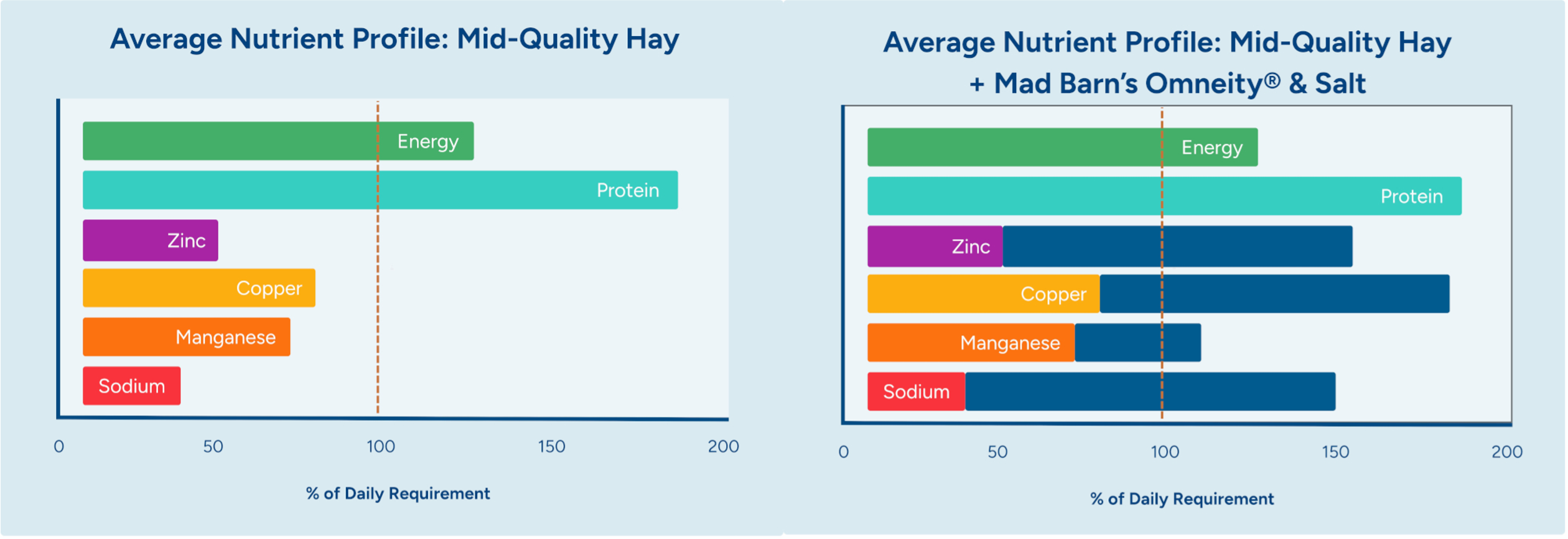
Grain doesn’t reliably solve the problem either. Most commercial feeds are only fully fortified when fed at relatively high intake levels, often far more than many horses actually receive. When intake drops, so does the intended supply of vitamins and minerals. What you’re left with is a diet that appears complete on paper but falls short in practice.
The real role of supplementation
That’s where a well-formulated vitamin and mineral supplement becomes essential. It allows you to correct imbalances without increasing calories, something especially important when many horses already consume more energy and protein than they need.
Across thousands of analyzed equine diets, the same deficiencies appear repeatedly. Sodium is often overlooked, yet it underpins hydration, nerve transmission and muscle contraction. Vitamin E and selenium work together to protect muscle tissue and support immune resilience. Meanwhile, copper and zinc are central to hoof integrity, skin health and connective tissue strength.
When these nutrients sit just below optimal levels, the effects are subtle but cumulative. Performance declines, recovery slows and structural quality begins to erode.
What separates an effective supplement from the rest
A supplement worth feeding does more than “fill gaps.” It must be built to actually balance a real-world diet. That starts with meaningful inclusion rates—levels that align with established requirements, not just label claims.
Trace minerals like copper, zinc, selenium and manganese should be present in forms the horse can absorb efficiently. Vitamins, especially A and E, must be supplied at levels that reflect the realities of hay-based feeding. A full spectrum of B vitamins adds further support for horses under stress or with higher metabolic demands.
Then there’s the structural side of the diet, amino acids. Lysine, methionine and threonine are frequently limiting, even when crude protein appears adequate. Without them, muscle development stalls, topline suffers and hoof quality plateaus regardless of how much biotin you feed.
And while biotin has its place, it only delivers results when the rest of the nutritional framework supports hoof tissue formation.
Equally important is what’s excluded. Many horses already consume excess iron through forage and water. Adding more only worsens mineral imbalances by interfering with copper and zinc utilization. A well-designed formula avoids this entirely.
Building a baseline: comprehensive daily support
This is where a product like Omneity® fits. It was designed from large-scale diet analysis to correct the most common deficiencies in a single step, rather than layering multiple products. By combining highly available trace minerals, full vitamin coverage, essential amino acids and digestive support, it simplifies feeding while supporting hoof quality, topline and overall condition.
When the standard approach isn’t enough
Some horses demand more than baseline coverage. Diets built on high-iron forage or horses dealing with metabolic issues require a more targeted strategy.
In those cases, a formulation like AminoTrace+ delivers a higher-impact nutrient profile, elevated copper and zinc, added magnesium and stronger antioxidant support. The goal shifts from simply meeting requirements to actively correcting imbalances that limit performance and health.
Remove the guesswork from your feeding program
Even with the right information, translating nutrition into a balanced daily ration isn’t always straightforward. Small imbalances are easy to miss without a full diet evaluation, and those gaps can quietly limit your horse’s progress.
If you’re unsure where to start, Mad Barn’s Horse Nutrition Calculator gives you a clear picture of what your horse is actually getting from their current diet and where it falls short. From there, you can make informed adjustments instead of relying on trial and error.
For a more precise approach, you can submit your horse’s diet for a free analysis from a Mad Barn equine nutritionist. You’ll get targeted guidance based on your horse’s individual needs, along with answers to the specific questions that matter for their health and performance.
Precision feeding changes everything
Choosing a supplement isn’t about adding more; it’s about aligning the diet with what the horse actually needs. The most effective programs eliminate redundancy, avoid unnecessary calories and focus on delivering nutrients in the right proportions.
When that alignment is in place, improvements aren’t marginal. They’re structural. You’re no longer managing symptoms, you’re removing the underlying constraints that were holding the horse back in the first place.
Landing page image by Getty Images