

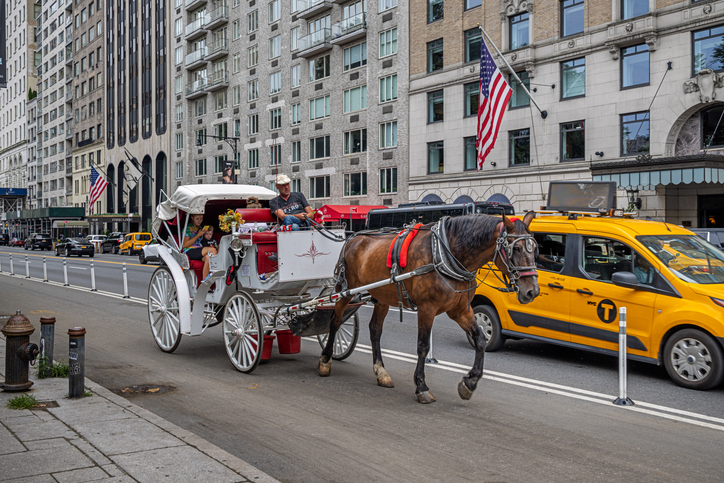
NEW YORK–New York City Council Speaker Julie Menin announced on October 14 that the Council would vote this week on Romanch’s Law. This legislation would finally phase out horse-drawn carriages in Central Park by June 1, 2028. It is also intended to ensure protections for the workers whose livelihoods have long depended on this historic tourist trade, a park tradition since 1863.
The landmark legislation follows the death of Romanch Mahajan. The 18-year-old was killed last June after being thrown from a runaway carriage in Central Park. As Central Park has become increasingly congested with pedestrians, cyclists and other micromobility users, community members and advocates have called for an end to the industry over infrastructure, safety and animal welfare concerns.
The Council will bring the bill to vote on October 22. There are currently 29 Council Members co-sponsoring the introduction.
Public safety liability
“The tragic and preventable death of 18-year-old Romanch Mahajan made clear that the status quo is no longer acceptable,” said Speaker Julie Menin. “Horse-drawn carriages have long been part of New York City’s history, but in an increasingly busy Central Park, this tradition has become a growing public safety liability. Next week, the Council will take decisive action by voting on Romanch’s Law to protect New Yorkers, visitors and the horses themselves.
“Just as importantly, the legislation will require the Administration to develop a plan to connect hardworking New Yorkers employed in this industry with new economic opportunities. We can honor our city’s traditions while recognizing when it’s time to move forward in the interest of public safety, protecting workers and strengthening our city’s economic vitality.”
On June 17, Speaker Menin announced the Council would hold a hearing to examine potential legislative action. It took place July 14. Council Members heard input from stakeholders, community members, City agencies and advocates throughout the day. The Council conducted a thoughtful review process to implement community feedback. Its goal: to produce a final, comprehensive version of the law. This is what the full body will now consider.
‘Right thing to do’
“When we introduced Romanch’s Law, we knew it was the right thing to do and that we needed to move quickly,” said Council Member Christopher Marte. “Our office worked hard to build a broad majority in the Council and keep the bill moving because, after the tragedies we witnessed this summer, there was no time to waste. Speaker Menin’s early public support helped put the pieces in place for the Council to act, and I thank her for working with us to finally bring this nearly 30-year debate to an end.”
If passed, the bill would prohibit the issuance of new carriage licenses. It would also prohibit the operation of all carriages beginning June 1, 2028.
In order to ensure a smooth workforce transition, the bill mandates that the Mayoral administration establish employment opportunity programs for carriage drivers and other workers in the industry. This would include referrals to relevant job opportunities, career counseling and job placement. There would also be hiring events and career fairs, identification of educational opportunities and tuition assistance programs. In addition, the bill mandates a program that would assist owners in finding humane disposition of their horses.
Speaker Menin’s office is forming a joint working group and has invited the Administration and labor to each have one representative serve alongside one Speaker’s office representative. The group will work through the transition and aim to improve outcomes for workers.
Protecting the horses and more
“The future of New York City’s horse carriage industry is a public safety and animal welfare issue that we can no longer ignore,” said Council Member Lynn Schulman, chair of the Committee on Health. “Our city’s streets have become increasingly congested, making it less safe for the horses, and we must take these risks seriously. We must also recognize the drivers and workers who have devoted years, and in some cases generations, to this industry, and ensure a responsible transition for them with meaningful opportunities for new employment.
“Speaker Julie Menin has been front and center in spearheading this effort to wind down the horse carriage industry, and I want to thank her for her persistence in making this important historic transition in our city’s culture. Our responsibility to protect these horses, keep New Yorkers safe and assist the drivers and workers in this industry is a top priority for the Council.”
“We’re deeply grateful to the Speaker for listening, championing this cause, and leading this coalition to make New York City safer and more humane,” said Steve Nislick, co-founder and president of NYCLASS. “This legislation means so much to those who have spent years fighting with us to protect horses and prevent tragedy. Thanks to Speaker Menin’s fortitude and compassion, New York City is finally poised to close this painful chapter.”
“We are immensely grateful to Speaker Menin for taking decisive action to end horse-drawn carriages in Central Park, and applaud Mayor Mamdani’s partnership,” said Betsy Smith, president and CEO of the Central Park Conservancy. “For the Central Park Conservancy, this has always been a matter of public safety. We hope for a safe phaseout over the next 20 months that will protect New Yorkers and ensure no one else ever suffers the fate of Romanch Mahajan.”