

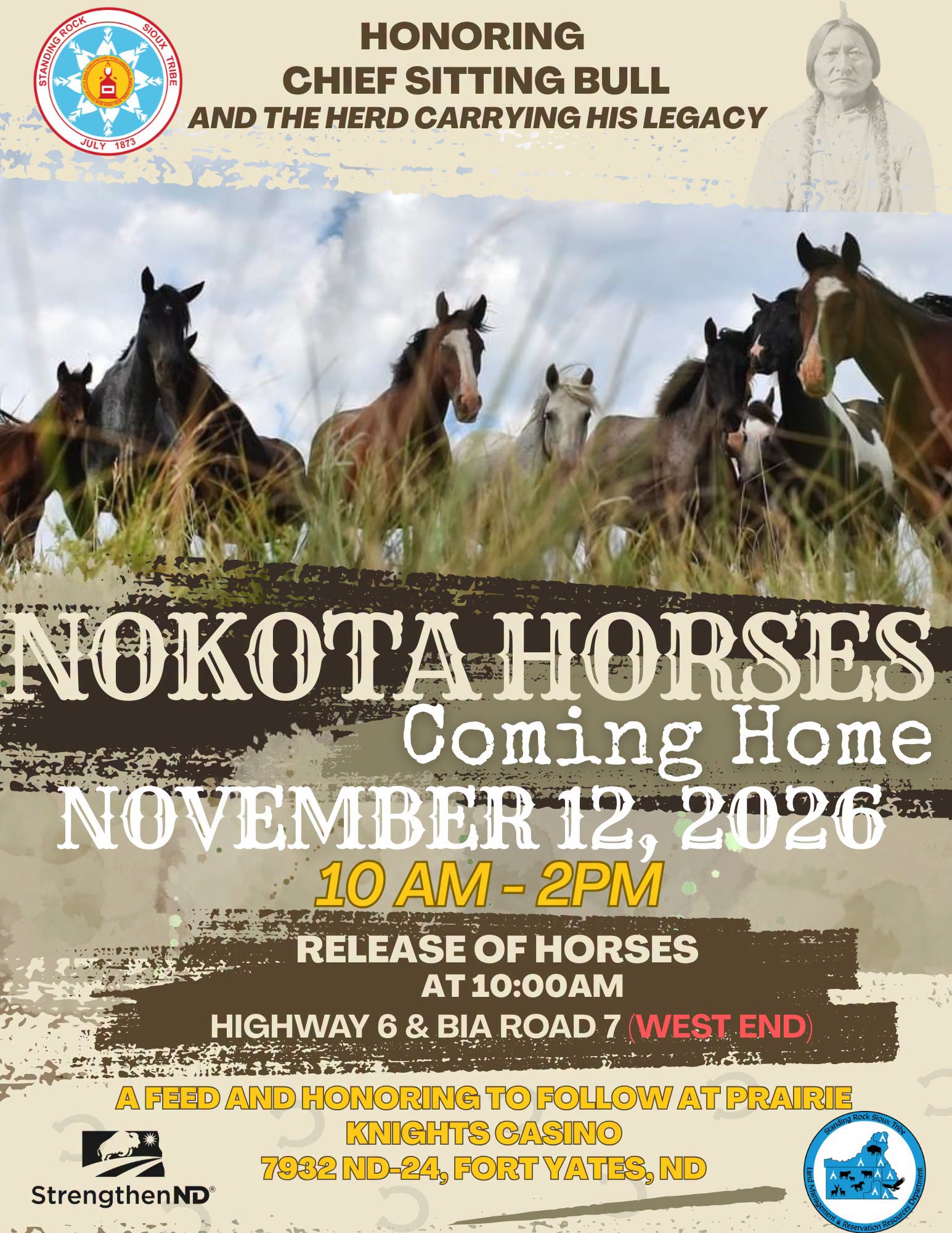
Fort Yates, ND—The Standing Rock Sioux Tribe is preparing to welcome a herd of Nokota horses to the reservation on November 12, 2026.
In a news release issued November 4, tribal representatives said the return of these rare animals to the Tribe will restore an important connection to their ancestral lands, honor the legacy of the great Chief Sitting Bull and strengthen the Tribe’s cultural relationship with the horse.
A horse with a history
Designated the Official State Honorary Equine of North Dakota in 1993, the Nokota horses are descendants of generations of feral horses that had roamed the Little Missouri Badlands since at least the 1880s. In the early 20th century, ranchers, in conjunction with government agencies, nearly eradicated them in an attempt to reduce competition for livestock grazing.
The creation of what eventually became Theodore Roosevelt National Park in the 1940s and ’50s resulted in perimeter fencing of that area, which lies within the Badlands. This accidentally trapped some of the horses within park boundaries.
What followed were decades of attempts by park officials to either eliminate the resident horses, cull them periodically to reduce their numbers (and thereby preserve park resources) or manage them in various ways. These included everything from the introduction of outside genetics to adoption programs to the use of immunocontraceptives.
Classified into traditional and ranch/performance types today according to their breeding, conformation and size, the Nokota horses are tough, intelligent and versatile. They are typically angular in build and often blue roan in color. Many exhibit a distinct ambling gait described as a “shuffle.”
Ensuring the breed’s future
For nearly 50 years, Linton, North Dakota, rancher Frank Kuntz has maintained a special herd of Nokota horses. He and his brother Leo had reportedly been purchasing horses thinned from the park’s herd starting in the late 1970s. Initially, they intended to cross the park horses with their own ranch horses. Later, in an effort to preserve the historic bloodlines of the park’s original strain of horses, the brothers founded the Nokota Horse Conservancy and breed registry.
However, in recent years Kuntz has faced illness, financial hardship and the death of his brother, not to mention the loss of most of his pastureland. Now, the Standing Rock Sioux Tribe has agreed to take over the care and management of roughly 100 of Kuntz’s horses, which represents the majority of his herd. Clearly, the transfer of Kuntz’s beloved horses to a group that is both uniquely respectful of the breed’s past and invested in their future could not come at a better time. As Kuntz Nokota Ranch representatives posted October 28 on the ranch’s Facebook page, “THIS is what we have been wanting and working towards since the very beginning! We cannot be more honored and blessed to have this joint venture.”
According to an article by Patrick Springer in InForum, the Standing Rock Sioux Tribe received a grant from Strengthen North Dakota to help offset the costs of transportation and veterinary care for the incoming horses, as well as provide feed and pasture.
Return of the relatives
Today the Nokotas remain powerful symbols of freedom and resilience in the face of great change. They are especially meaningful to the Standing Rock Sioux Tribe because of their link to Hunkpapa Lakota leader Sitting Bull (Tȟatȟáŋka Íyotake) and the horses that accompanied him and his people when, driven largely by hunger, they finally surrendered to US forces in 1881.
It is also important to note that the Oceti Sakowin (the alliance of the Lakota, Dakota and Nakota people) consider horses their sacred relatives.
“These relatives are not only genetically distinct from other horse breeds across the continent but descended from the same horses that Sitting Bull set loose when he returned from Canada,” explained Tribe Chairman Steve Sitting Bear in the Tribe’s news release. “They were released in recognition of the changing world our leader was faced with, but we’ve held on to the horse and our horse culture in the decades since. We’ve missed these relatives.
“By bringing them home, we are taking a step towards reuniting with our ancestors and healing our traumas,” stated Sitting Bear.
Tribe members reportedly hope to use the Nokotas in addiction recovery programs and youth programs such as their horse camps. The herd is also expected to help teach future generations about the Tribe’s historic connection to horses.
The homecoming
The Standing Rock Sioux Tribe will celebrate the return of the Nokota horses in a public release and honoring event on November 12, starting at 10 a.m.
The Tribe invites the community to join in welcoming their relatives home and honoring the legacy of Chief Sitting Bull. For more details, email info@standingrock.org or contact the Tribe office at (701) 854-8500.
Landing page image taken by Seth Zeigler at the Nokota Horse Conservancy, Linton, North Dakota; public domain