

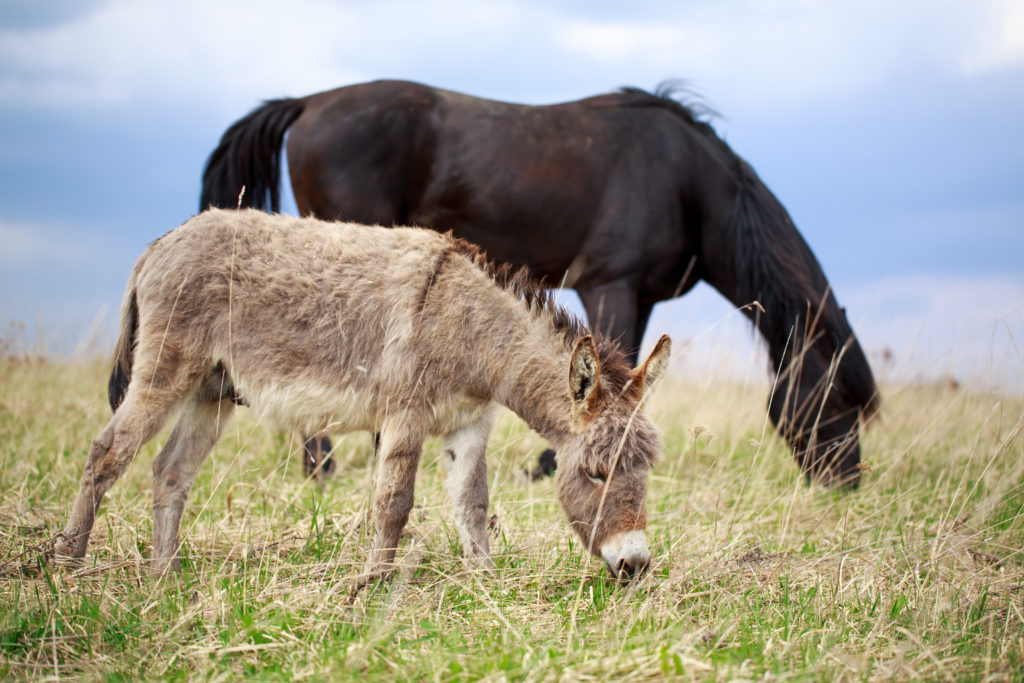
Horses are not the only members of the family Equus. Domestic donkeys, wild asses and also the zebra all belong to the genus Equus. Asses have been domesticated for thousands of years.
In Egypt and Mesopotamia they were in general use between 4,000 and 3,000 BC. This was approximately the same time period that horses were beginning to be domesticated in Asia.
Facts
Donkeys differ from horses in a number of ways. The most obvious difference, of course, is their ears, which are much longer than those of the horse (many of their fans call them “Long Ears”). Also these equids, unlike horses, do not have chestnuts on their hind legs. In addition, they have five lumbar vertebrae instead of the six that horses have. You might also notice that rather than the flowing tail of a horse, they sport a tufted tail that is more like that of a cow.
Male donkeys are known as “jacks” and the females are known as “jennets” or “jennies.” Donkeys range in size from the Miniature at between 36 and 38 inches, through the Standard at 11 hands (44 inches) to the American Mammoth Jack which can reach 16 hands (64 inches) at the withers.
Uses
Donkey fans consider donkeys as versatile as horses. Indeed, judging from the various classes in which they are exhibited at shows, they can easily turn a hoof to most activities.
Miniature donkeys are popular as pets and companions and are shown in halter classes. Standard donkeys are trained to harness and can also be ridden by children. Larger donkeys, such as the Mammoth Jack, are used as draft animals and ridden.
Donkeys are used in therapeutic riding programs and as working animals throughout the world, just as they have been for centuries.
This website has some excellent articles on the training of donkeys, for both riding and driving.