

Listen here:
A relatively simple piece of technology can help differentiate horses with trigeminal-mediated headshaking (TGMHS) from those whose behavior originates from other problems.
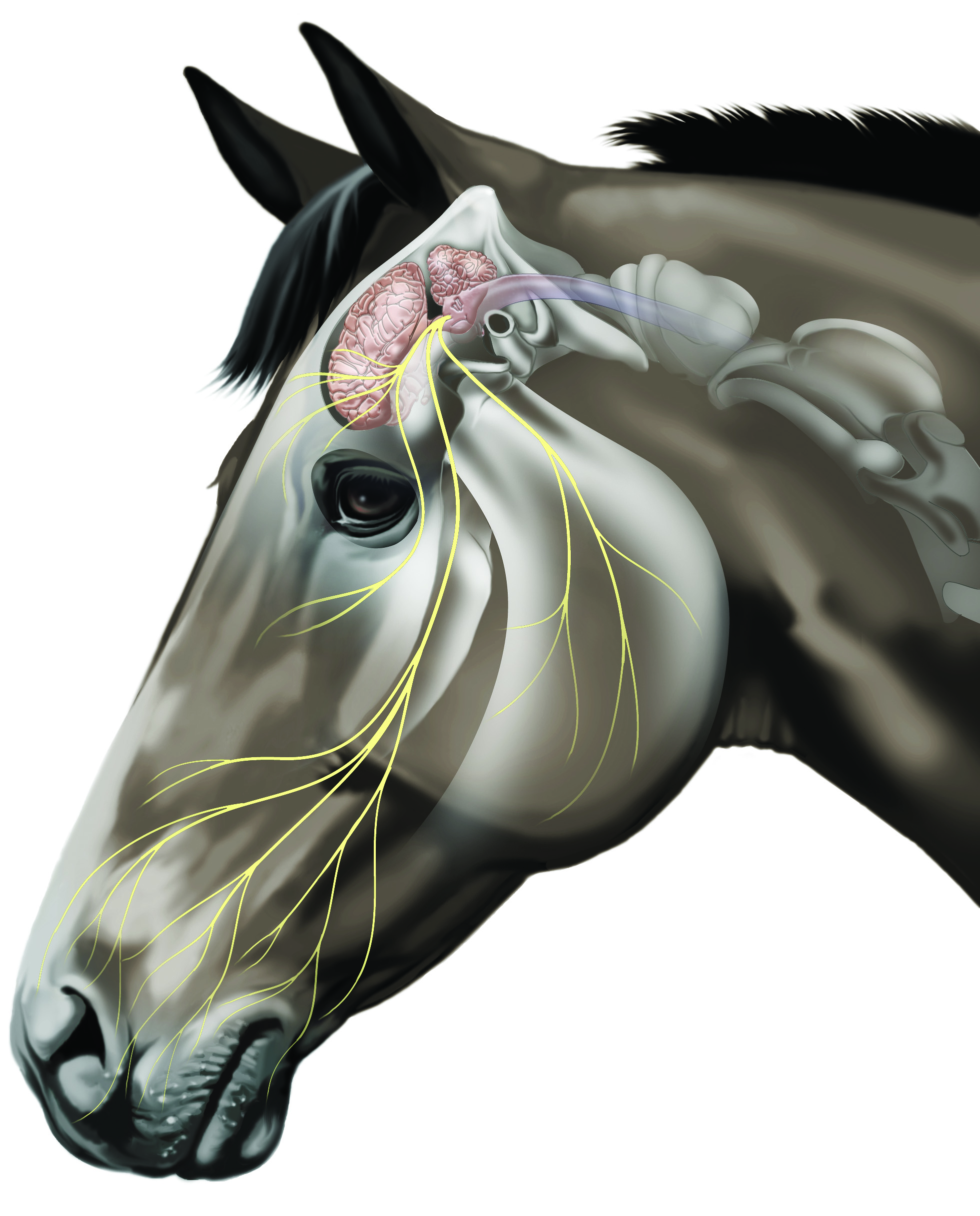
Horses with TGMHS experience intermittent, severe facial pain along the trigeminal nerve, which extends from the brain down the side of the face to the muzzle.
Signs include violent vertical head flicks—as if a bug flew into the horse’s nostril—muzzle rubbing, snorting and even striking at the face with a foreleg. Veterinarians generally diagnose TGMHS by ruling out other potential causes.
Looking for a more objective means of detecting and measuring TGMHS, researchers at the Universities of Nottingham and Bristol in the United Kingdom fitted the halters of 56 horses with accelerometers attached at the crown piece (poll). Forty of the horses had been diagnosed with TGMHS, headshaking with another cause or lameness. The remaining 16 horses served as controls.
The horses were trotted on a longe line for five minutes, while the accelerometer collected data on the direction and speed of their head movements. Analysis showed that the characteristics and frequency of vertical head movements made by horses with TGMHS differed significantly from those of the other horses. TGMHS caused horses to move their heads more frequently and with greater force.
“These rapid acceleration-deceleration peaks are associated with the head movement described by owners as when the horse looks like it has received a sudden electric shock to the muzzle or been stung by a bee up its nose,” note the researchers. They conclude that “accelerometer use may aid headshaking diagnosis and monitoring of management strategies.”
Reference: “Use of a poll-mounted accelerometer for quantification and characterization of equine trigeminal-mediated headshaking,” Equine Veterinary Journal, July 2024