

The nature of a horse’s whinny, or neigh, has long been a subject of interest among scientists. A combination of two tones known as biphonation, with both high and low pitches, it most closely resembles the sound made by small rodents. However, this type of biphonation is unknown among larger mammals other than horses. Even equine cousins like donkeys and zebras don’t make the same noise. So how is it produced?
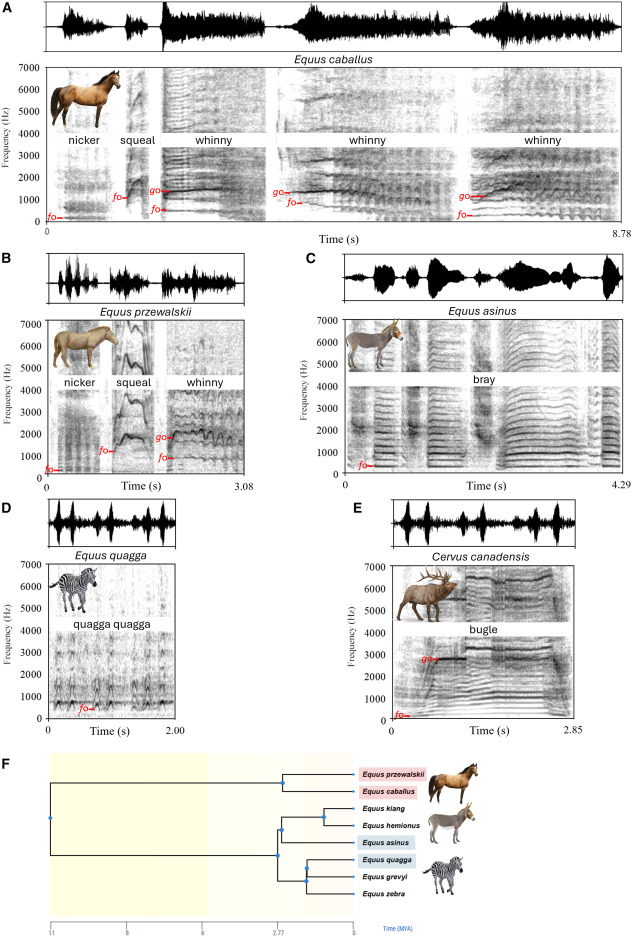
A study published Feb. 23 in Current Biology, a Cell Press journal, reveals that while the lower of the two sounds is made in the usual way—with air passing over tissue folds in the voicebox (larynx) to create vibration—the higher sound is actually a whistle.
And here’s the thing: Unlike a human whistle, which is produced through the mouth, the equine whistle begins in the horse’s larynx and involves the contraction of “intrinsic laryngeal muscles.” This, scientists say, draws nearby cartilages closer together, creating a slit-like opening through which a whistle is generated in another aerodynamic process.
‘Fo’ and ‘go’
Elodie Mandel-Briefer of the University of Copenhagen reportedly co-led the study with Professor William Tecumseh Fitch of the University of Vienna. The scientists took endoscopic video and acoustic recordings of 10 stallions during natural vocalization. In addition, they made CT scans of and conducted experiments with the larynxes of cadaver horses using helium gas. Horses affected by recurrent laryngeal neuropathy (RLN) were also used for the comparative analysis.
So what is the purpose of this unique sound (which scientists divided into “fo” and “go” to represent the low- and high-frequency components, respectively)? According to Mandel-Briefer, these two-part whinnies might help horses communicate various messages simultaneously. Neighs at different pitches could possibly express a more complex range of information and/or emotions, Mandel-Briefer conjectured.
An evolutionary perspective
“Turning to an evolutionary perspective,” the published study discussion reads, “the capacity to produce high-frequency sounds that defy acoustic allometry [a corresponding relationship to animal size] also appears in other perissodactyls [the order of odd-toed ungulates to which Equidae belongs]. For instance, Malayan tapirs (Tapirusindicus) produce high-frequency squeals and whistles, and southern white rhinoceros(Ceratotherium simum simum) produce whistle-like ‘whines.’
“Although the biomechanics of these calls remain untested, their unusually high frequency raises the possibility that aerodynamic whistlesound production mechanisms could be a shared ancestral trait or a convergent adaptation within the order Perissodactyla,” the study discussion continues.
“However, the domestic horse (and likely the Przewalski’s horse) appears unique in its ability to simultaneously couple this aerodynamic whistle with standard laryngealphonation (fo) to create a biphonic signal, whereas other, more distantly related equids like plainszebras and domestic donkeys appear to rely primarily on vocal fold vibration.”
Conclusion
In conclusion, the scientists write: “To our knowledge, this study provides the first demonstration of simultaneous aerodynamic whistles and vocal fold vibration during biphonation in any species. It also provides the first clear experimental evidence of a laryngeal whistle in a non-rodent mammal.”
To read the full article, click here.
Landing page image: Getty Images/mhaidbauer