

Grazing muzzles are usually used to prevent pasture-associated laminitis0 or simple overeating by slowing grass intake, but new research suggests that they can also help protect horses from another feeding-related problem: choke.
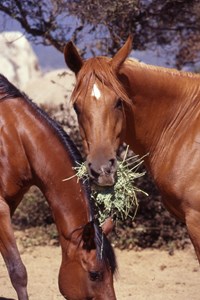
When a horse chokes, his esophagus becomes blocked with feed material. He can still breathe but can’t swallow, and prolonged or repeated choke episodes can lead to potentially deadly complications such as extensive esophageal scarring and pneumonia. Bolting feed—eating too fast without chewing sufficiently to moisten and soften feed—is one of the primary risk factors for choke.
Using eight mature horses, researchers at Southern Illinois University devised an experiment to determine whether grazing muzzles could slow grain intake. The researchers measured how much grain the horses would consume in 10 minutes under three conditions: without a muzzle, wearing a muzzle with a small, circular opening on the basket and wearing a muzzle with a large, rectangular opening. The experiment was repeated daily for five consecutive days under each condition.
The researchers found that, overall, the muzzles significantly slowed each horse’s grain consumption, which could reduce the risk of choke. However, they note that by the end of the five-day trial, horses wearing the muzzle with the circular opening managed to eat at almost a normal rate, which suggests they had adapted to the design. The researchers also determined that muzzles with square openings allowed a large amount of grain spillage.
Despite these challenges, researchers are optimistic about the applications of grazing muzzles in preventing choke. They call for more research to learn how owners might use muzzles in a way to consistently slow grain intake while minimizing waste.
Reference: “Effect of grazing muzzles on the rate of pelleted feed intake in horses,” Journal of Veterinary Behavior, January–February 2016
This article first appeared in EQUUS issue #464, May 2016.