

According to a recent news release from Texas Tech University, two fourth-year students at its School of Veterinary Medicine have much to be proud about.
Kayden Tanner and Marshall Mays have been published in international journals after putting hundreds of hours into their research papers. Their work centered on specific issues in equine and canine health, respectively.
The research
Tanner’s paper, “Genomics in Equine MEED: whole-genome sequencing and target mutation identification,” addressed a rare equine disorder, multisystem eosinophilicepitheliotropic disease. MEED is so severe and progressive that horses are usually euthanized within one year of diagnosis. Animals not only shared Tanner’s work but selected it as the journal’s feature article.
Tanner was able to sequence the whole genome of this chronic wasting disease in horses and make that information public as his contribution to the field of veterinary science. His findings provided insight into the potential underlying cellular mechanisms of MEED. The data can be used to further understand the disease and even develop therapeutic strategies.
May’s paper, “Evaluating the synergistic effects of cisplatin and tamoxifen in canine osteosarcoma cells,” was published in Frontiers in Veterinary Science. This research has One Health implications, as it offers a potential treatment for this form of bone cancer in dogs.
Student mentorship
The opportunity for these research projects came from the laboratory of Thu Annelise Nguyen, the associate dean for research and a professor of toxicology, and mentorship from her postdoctoral fellow, Tomas Lugo.
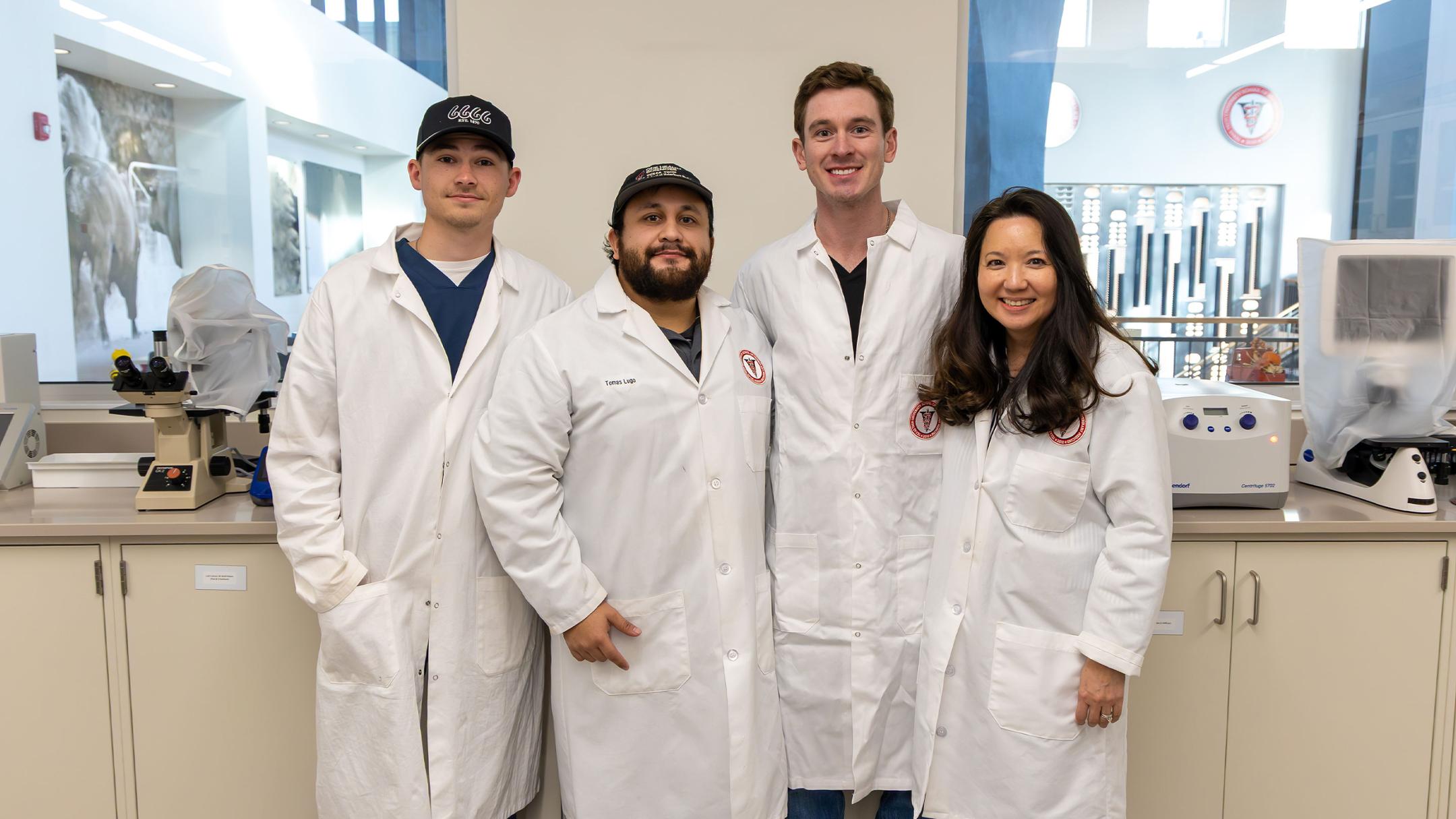
Lugo not only answered questions and provided coaching to the two students but also created the modeling and computational approach that earned him a star next to his name as the corresponding author of both papers. This is an honor no student has achieved before at the School of Veterinary Medicine.
Nguyen is proud of Lugo’s commitment to the students as he helped them transition from quiet observers to inquisitive minds who were conducting experiments. She also applauded the dedication displayed by Tanner and Mays, who showed up to school at 6 a.m. and even worked through a week of Christmas break.
“This is a big deal for veterinary scholars because they had never worked in science before,” she said. “For Tomas and me, it’s our job to do this. But for trainees to get this done in the time span they did is huge.”
Furthering career plans
Besides furthering the understanding of these diseases, the research projects bolster the students’ applications to earn internships. These internships will be needed for them to one day become surgeons.
Tanner is thankful his research has led to connections that will not waver moving forward.
“Tomas has helped us through this whole process and been there for us when we needed him, and he’s been areally good friend,” Tanner said. “He will always be somebody I depend on and lean on in the research aspect.”
“Then Annelise, the same thing. She threw us a bone when nobody else would, was there for us, wanted to seeus succeed and gave us every opportunity to do so. For that, I’ll forever be grateful to her.”
‘A great learning experience for everyone’
As for Lugo, guiding two inexperienced researchers to publication confirms he can push a project through to completion. This is useful as he applies for grants from federal and private institutions. He feels reassured that he’s chosen the right career path: to become a professor leading his own lab one day.
“It was really good seeing them mature over time, just like me,” Lugo said. “I was more focused on one task, but after I gained more confidence, I was thinking about the bigger picture. So, it was a great learning experience for everyone. And that’s my main goal: to make great opportunities not just for myself, but for the students.”
About the Texas Tech University School of Veterinary Medicine
Texas Tech University’s School of Veterinary Medicine is located in Amarillo, Texas. Its mission is to serve the veterinary educational and service needs of rural and regional communities and provide access to affordable, high-quality education.
Landing page image by Getty Images