

A recent Swiss study suggests that a “wait and see” approach may be justified for younger horses with stable, small sarcoids because a large percentage of the tumors spontaneously regress without treatment.
Sarcoids, the most common skin tumors of horses, are caused by the bovine papillomavirus, but the mode of transmission is not fully understood. Treatments include surgical excision, freezing, chemotherapy and antiviral drugs, but none are consistently successful.
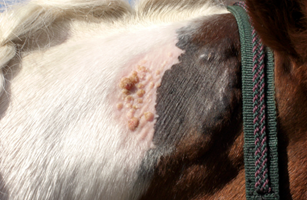
Researchers from the University of Bern tracked 61 3-year-old Franches-Montagnes horses with “milder manifestations” of sarcoid tumors, along with a control group of 75 sarcoid-free horses of the same breed and age. Each horse was examined twice over a five- to seven-year period, and owners or caretakers were asked to fill out questionnaires.
Click here to learn 5 ways to protect your horse’s skin.
The researchers found that 38 (62 percent) of the horses who had sarcoids when the study period began were free of the tumors at their second exam. Of those horses, 29 had received no treatment, meaning the tumors regressed on their own. Occult tumors—typically flat, gray and hairless —were most likely to spontaneously regress, going away on their own 65 percent of the time. Verrucous sarcoids—which have a wart-like appearance—disappeared without treatment 32 percent of the time. The researchers could identify no environmental factor that would have caused the tumors to subside.
Noting they were surprised at the high level of spontaneous regression of the tumors, the researchers advise caution when interpreting results of non-control group studies of sarcoid treatments. They emphasize, however, that owners must closely monitor sarcoids for any increase in size—tumors that show rapid and aggressive growth are best addressed by a veterinarian.
Reference: “Clinical course of sarcoids in 61 Franches-Montagnes horses over a 5-7 year period,” Veterinary Quarterly, December 2016
This article was originally published in EQUUS #473
Don’t miss out! With the free weekly EQUUS newsletter, you’ll get the latest horse health information delivered right to your in basket! If you’re not already receiving the EQUUS newsletter, click here to sign up. It’s *free*!