

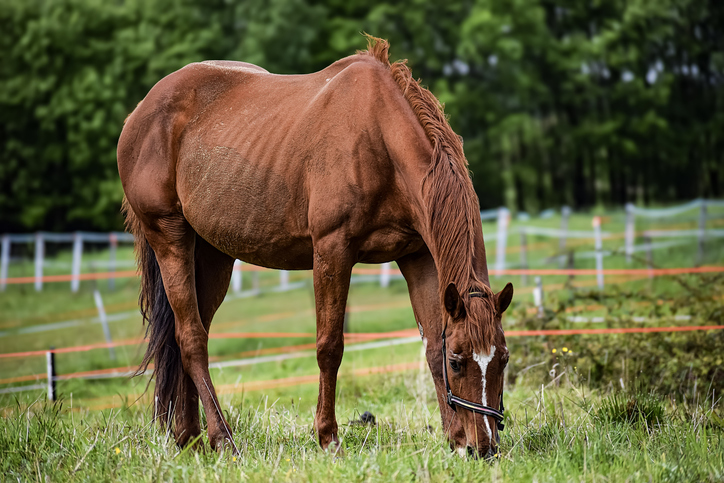
Your horse has started shedding his winter coat, and suddenly you notice he’s looking tucked up, even a bit ribby. You run your hand down his spine and discover that his topline isn’t as robust as it used to be. Has he lost weight?
At a moment like this, the impulse is often to reach for another scoop of feed. However, it’s not always that simple.
Pinpointing the exact reason for your horse’s weight loss is essential to fixing the problem. First, enlist your veterinarian to help rule out any health issues. Then, work with your veterinarian and/or an equine nutritionist to get to the bottom of any dietary deficiencies. Ultimately, it may be wise to consider a nutritional supplement that targets your horse’s specific “limiting factor(s).”
Start with the horse
To determine what those “limiting factors” are, begin with an honest assessment of your horse’s current status:
- What does the horse’s topline look like, and what is his body condition score?
- Is the horse otherwise healthy? Any illness or history of gastric discomfort?
- How is the horse’s appetite?
- Is the horse getting good quality forage (not stemmy and tough) in sufficient amounts, and in frequent feedings?
- Does the horse’s manure appear normal and consistent every day?
- What is the horse’s workload (or breeding status, if a stallion or mare)? Has it been more demanding lately?
- Is this a senior horse?
- Has the horse been dewormed regularly?
- Dental status—is the horse dropping feed?
- What kind of turnout does the horse get, and is there social/herd competition? Is the horse subject to extreme cold for extended periods?
‘Limiting factors’ and supplementation
Now let’s say you, your veterinarian and possibly your equine nutritionist have weighed all of the above. You’ve also confirmed that you are indeed feeding a forage-first diet with quality protein, adequate calories, balanced vitamins and minerals (including salt) and water.
The rule of thumb with nutritional supplements is that they should support a good program, filling any gaps—no more, no less. In other words, they should be targeted to the individual need. A supplement that transforms one horse into a showstopper may do nothing for another. Why? Because it’s addressing a different deficit.
Let’s examine four “limiting factors” that might cause weight loss in horses, with supplement recommendations from Mad Barn.
Limiting factor #1: Insufficient digestible energy
For horses that primarily need more calories, fat is one of the most efficient tools available. It provides substantially more energy per gram than carbohydrate or protein, allowing the diet to become more calorie-dense without sharply increasing meal size.
That is useful for hard keepers, senior horses, horses in regular work and animals that do not tolerate large grain meals. Fat-based calories are often described as “cool calories” because they increase energy intake without the high starch load that many owners associate with excitability or digestive disruption.
Common fat sources in equine diets include vegetable oils, stabilized rice bran, flax products, camelina oil and high-fat commercial feeds or supplements. Oils that also provide omega-3 fatty acids may offer additional nutritional value while helping to support body condition.
Because fat is concentrated, it should be introduced gradually. The goal is not to overwhelm the ration with oil, but to make the overall diet more energy-dense while preserving forage intake and digestive comfort.
For many horses that simply need extra calories or more dietary energy to gain weight, Mad Barn’s W-3 Oil provides the best overall calorie support.
This is a DHA-enriched fat supplement that provides concentrated energy along with omega-3 fatty acids. It is also formulated with natural vitamin E support for skin, coat, joints, respiratory function and the normal regulation of inflammation. This combination is especially useful because it provides fat-based energy without the excitability/digestive risk often associated with high-starch grain.
Choose W-3 Oil when the main problem appears to be calorie intake. Signs may include visible ribs or hips, weight loss during winter or heavy work, difficulty holding condition or a need to add energy without increasing the bulk of the ration.
Caveat: A fat supplement won’t correct every cause of poor condition. If the horse is not eating enough forage, has poor dental function, is dealing with pain, or is missing key nutrients, the broader ration and health picture still need attention.
Limiting factor #2: Eating enough but not using it well
Sometimes, calories are not the answer. Some horses consume what looks like enough quality feed but fail to maintain condition. In those cases, the issue may be how efficiently the horse chews, digests, ferments, absorbs and uses the nutrients in the diet.
Much of the horse’s usable energy comes from hindgut fermentation. Microbes in the cecum and colon break down fiber from hay and pasture into volatile fatty acids, which the horse absorbs and uses as fuel. When that microbial community is disrupted, fiber digestion and feed efficiency can suffer.
Stress, abrupt diet changes, travel, inconsistent forage intake, aging, illness and hindgut dysbiosis can all affect digestive efficiency. The horse may be eating, but not extracting as much usable nutrition as expected.
Signs that point toward a feed-efficiency problem include poor condition despite a good appetite, inconsistent or loose manure, difficulty holding weight during stress, and a general sense that the horse “doesn’t do well” on feed that should be adequate.
A horse that eats enough but remains hard to keep may benefit from Optimum Digestive Health, a Mad Barn supplement that supports hindgut function and feed efficiency.
It does not supply calories in the same way a fat supplement does. Instead, it supports the digestive environment that helps a horse make better use of forage, feed and supplements already in the ration.
The Optimum Digestive Health formula includes probiotics to help maintain beneficial hindgut microbes, prebiotics that support microbial activity, and yeast and fermentation products to encourage fiber-digesting bacteria. It also contains digestive enzymes to support nutrient availability and toxin binders to help reduce the effects of undesirable compounds in feed.
This kind of support can be useful for horses with inconsistent manure quality, reduced feed efficiency, stress-related digestive challenges, or difficulty maintaining weight despite apparently adequate intake.
For a horse that needs both more calories and better digestion, Optimum Digestive Health can be paired with W-3 Oil. In that combination, W-3 Oil raises digestible energy intake, while Optimum Digestive Health supports the digestive function needed to use the total ration more effectively.
Limiting factor #3: Low appetite, gastric discomfort
Some horses fall behind in condition because they simply fail to consistently consume enough feed. Low appetite, picky eating, stress or abdominal discomfort can all limit calorie intake long before the owner has a chance to build weight.
The stomach is a common source of discomfort in horses. This is particularly true of those in stressful routines, heavy work or management situations that leave them without forage for long periods. When a horse is reluctant to eat or eats inconsistently, supporting stomach comfort can be part of the weight-gain plan.
Visceral+ is Mad Barn’s recommendation for horses that need support for appetite, gastric function and abdominal comfort.
It is designed to help maintain a healthy stomach environment and support normal digestive function. This, in turn, can encourage more consistent feed intake.
The formula includes lecithin to help maintain the stomach’s protective lining, as well as nucleotides to support healthy gastric tissue and normal repair processes. It also contains glutamine as an energy source for digestive tract cells and mannan-oligosaccharides to support mucin production in the gut.
For horses that need additional calories as well as digestive comfort, Visceral+ can be used alongside W-3 Oil. The two products address different parts of the problem: One supports intake and stomach health, while the other increases calorie density.
Limiting factor #4: Poor muscle development
A horse can look thin without being truly short on body fat. The ribs may be covered, yet the topline is weak. The back may look flat, narrow or dropped. The hindquarters may lack fullness. In these “underdeveloped” horses, more calories alone may not solve the problem.
Muscle development depends largely on appropriate exercise, adequate calories and sufficient protein quality. Protein quality is key because horses need essential amino acids to build and repair muscle. If one essential amino acid is in short supply, it can limit how well the horse uses the rest of the protein in the ration.
Lysine, methionine and threonine are commonly “limiting” amino acids in equine diets. Diets based heavily on mature hay or lower-quality forage are frequently to blame. They might provide enough crude protein in a hay analysis but still fall short in the amino acid pattern needed for topline and lean tissue (muscle) development.
A horse with poor muscle development may benefit from Mad Barn’s Three Amigos.
This supplement contains the three commonly limiting amino acids—lysine, methionine and threonine—in a pure, balanced form. The blend is designed to support muscle protein synthesis, topline maintenance and lean muscle development.
Lysine is often the primary limiting amino acid in equine diets and is central to muscle protein synthesis. Methionine supports protein synthesis, tissue development, hoof quality and methylation pathways involved in normal metabolism. Threonine supports muscle protein synthesis, gut barrier function, immune function and normal tissue maintenance.
Three Amigos is especially useful for horses with poor topline, higher protein requirements, mature-hay diets, or adequate body condition but poor muscle development.
However, amino acid supplementation should not be treated as a replacement for calories when a horse is truly underweight. If the horse is ribby and experiencing an energy deficit, calorie intake still needs to increase. But if the main issue is muscle, not fat, targeted amino acid support may be the more precise tool.
Selecting the right support
The best supplement is obviously the one that matches the limiting factor you’re trying to address. Some horses need one kind of support. Others need a combination approach because calorie intake, digestive issues and amino acid supply can overlap.
Choose W-3 Oil when the horse needs more calorie-dense energy, struggles to maintain body condition, has higher energy requirements because of work or weather, or needs more calories without heavy reliance on starch and grain.
Optimum Digestive Health is your best option when the horse appears to eat enough but still struggles to maintain condition, has inconsistent manure quality, or may not be using the diet efficiently because of hindgut imbalance, stress or poor digestive function.
Select Visceral+ when low appetite, fluctuating intake, gastric discomfort or high ulcer risk may be limiting how much feed the horse actually consumes.
Three Amigos can help when the horse lacks topline, appears narrow despite adequate body fat, has poor muscle maintenance in work or may be limited by protein quality and amino acid intake.
Supplement comparison at a glance
| Product | Best for | Primary role | When not to rely on it alone |
| W-3 Oil | Horses needing additional calories; weight gain support; improved body condition | Calorie-dense fat, omega-3 fatty acid support, natural vitamin E | Poor digestion, inadequate forage intake, poor overall diet balance or amino acid deficiency |
| Optimum Digestive Health | Horses eating enough but not maintaining weight; poor feed efficiency; digestive support needs | Hindgut, microbiome and nutrient-utilization support | Insufficient calorie intake, severe underfeeding or diets lacking adequate forage or energy |
| Visceral+ | Horses with abdominal discomfort, poor appetite or stomach-support needs | Gastric, microbiome and digestive support | Low energy or protein intake, severe digestive dysfunction or imbalanced diets |
| Three Amigos | Horses lacking topline or muscle despite adequate calorie intake | Essential amino acid support and muscle protein synthesis support | Underweight horses with calorie deficits, inadequate forage or poor overall diet balance |
Final thoughts
The best equine weight gain supplement is the one that addresses the main reason for you horse’s condition after potential health issues have been ruled out by your veterinarian.
Supplements can be useful, but they work best as part of a complete feeding program. Adequate forage, proper calorie balance and high-quality protein with vitamin and mineral balance remain the foundation. Regular dental care, parasite control and veterinary oversight are vital parts of that foundation, as well.
For individualized guidance, submit your horse’s diet for a free evaluation by Mad Barn’s equine nutritionists. A diet evaluation can help identify whether your horse needs more calories, better feed utilization, amino acid support, stomach support or a combination plan