

A recent study by British and Italian researchers has concluded that the death of a horse’s equine companion “likely impacts the emotional welfare” of the surviving horse to differing degrees. Many horse owners have noticed grief-like behaviors in such situations. But are these merely a response to a disruption in routine, or something more profound?
The researchers’ findings, published last November in Applied Animal Behaviour Science and accessed through ScienceDirect, hinged on an online survey completed by the owners of 325 horses who had lost an equine companion. According to the study abstract, “The research built on recent research on grief in domestic dogs (Uccheddu et al., 2022), which found that the relationship between dogs affected the activities and emotions of the surviving individual following the death of a familiar dog companion.”
Data collected in this fashion is obviously subject to human interpretation. Nonetheless, it provides valuable insights into consistent patterns that would have been difficult to procure any other way.
Strong bonds, reactions of distress
Getty Images
Gregarious by nature, horses often form lasting bonds within their own social circles. This study suggests that, as with other species, the closer the bond, the more deeply the loss of a horse’s companion is felt.
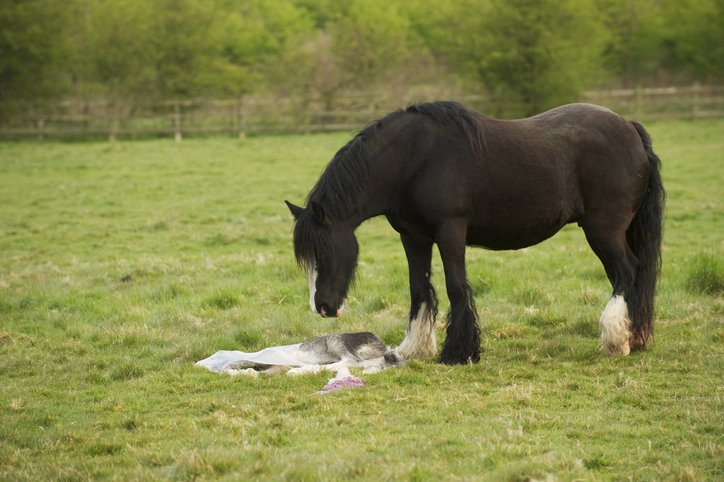
Anecdotal accounts describe everything from horses lying down next to a deceased friend to grief-like behaviors of mares whose foals are dying or have died. Among the most common behaviors noted in surviving horses within 24 hours of a companion’s death were the following:
- Agitation or arousal (88.96%);
- Changes in interactions with both other horses and people, often around feeding time (77.64-.67%);
- Heightened alertness to stimuli (72.92%); and
- Vocalization or calling out (68.63%).
Overall, the picture painted was that of a state of restlessness, anxiety or distress.
In addition, everyday activities like sleeping and eating seemed especially difficult at first for those who had witnessed the passing of a buddy firsthand. These horses reportedly appeared unusually stressed or hypervigilant about things around them.
Useful takeaways
Interestingly, horses with access to the deceased friend’s body seemed to recover more quickly from the trauma of loss. That is not to say that they returned to normal behavior within the first 24 hours. However, over the long term, their altered behavior did not linger like that of the horses who had not viewed or spent time with the body. The latter group, researchers noted, took as long as six months to return to a more balanced behavioral state.
Although further research is warranted, there are two useful takeaways from this study. The first is that the death of a horse can have “negative consequences” on the emotional welfare of that horse’s companions, with the degree of the impact dependent on various factors. The second: that time spent with a deceased friend’s body can help a horse process the loss.
As for whether the behavior horses exhibit after a companion’s death constitutes grief in the sense that we know it, the researchers stopped short of drawing that conclusion. However, their work offers a new basis for comparison and could be helpful information for anyone concerned with the well-being of their horses.
Landing page image from Getty Images