

On a frigid January night in 1861, three months before shots were fired upon Fort Sumter, more than 2,000 sportsmen, society ladies, clergy members and schoolboys gathered outside of Niblo’s Garden theater in Lower Manhattan. Those New Yorkers likely had little in common except for one thing: They were eager to see the most famous horse trainer in the world.
Finally, the doors opened and the crowd rushed in, with six policemen shouting orders to keep control. As they took their seats, spectators likely noticed an unusual scent permeating the theater air, coming from the thick layer of sawdust that had been laid down over the stage floor.
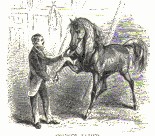
Cruiser, a living example of Rarey’s training expertise, became part of his show.
An hour later, the curtain rose on a stable scene with hay and a makeshift stall. A rope separated the stage from the front row. Out strode John Solomon Rarey to ringing applause. A slim and nimble man, Rarey had reddish hair, a thick moustache and a gentle manner. His clothes were European in cut, his jacket snug, boots shining. His eyes, gray and steady, were the only thing that suggested his rare gifts.
On Rarey’s command a shining black stallion, Cruiser, bounded over to him. The horse whickered and lowered his head and nuzzled Rarey affectionately. The two then swirled in synchronized dance step, wheeling and spinning before the crowd. In response, the audience whistled and stamped in approval. Once famous as the most vicious horse in England, Cruiser was now the living embodiment of Rarey’s genius.
But Rarey was just getting started. Now he would demonstrate his technique with the horses of ordinary people. A group of local owners presented him with horse after unmanageable horse on which to demonstrate his mastery. On this night, the equine contrarians included a bull-headed carriage horse, a horse who refused to accept so much as a halter and a notorious biter.
The show begins
This was the real show. Rarey started each session by allowing the horse to sniff him, approaching and retreating. Then he patted the horse’s body all over in turn. If the horse still resisted, by lunging and bucking, Rarey would bind a foreleg with a leather strap (the same technique featured in the 1998 film “The Horse Whisperer”). In some cases, he would get the horse to lie down and then sit beside him, sharing calming words and touch.
Some of Rarey’s lessons took minutes, others hours. But all came to the same satisfying conclusion: A reformed horse, calm and happy, ready to serve his owner as never before.
At Niblo’s Garden that night, when the last horse was quieted, Rarey stood covered with “sawdust and glory”—in the words of one reporter—and addressed the audience: “I renew my challenge to the world,” Rarey said. “I will take any and every horse that can be brought to me and will tame him.”
America’s greatest horse tamer had come home.
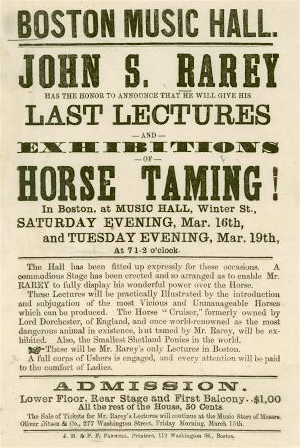
Made in America
John Solomon Rarey was born in 1827 in Groveport, Ohio. Even as a child, he was a keen observer of horses, and he started training them at age 12. A few years later, he traveled to Texas and Kentucky, watching broncobusters, learning from different trainers and eventually developing his own theory of how best to handle horses: Training did not need to involve whips, spurs and blood, he decided, there was a better, more humane way, using time and tolerance and showing neither fear nor anger.
Rarey wrote a book and offered clinics, but he couldn’t get people interested in his ideas. Then he met a man named Horace Goodenough who boasted of connections in Europe, home of the most advanced horsemanship traditions.
Leaving behind everything he knew, Rarey accompanied Goodenough to England in 1858. He was not alone. The mid-19th century was a vibrant period of transatlantic intellectual exchange that influenced literature, philosophy, education and technology in both the United States and Europe. As Rarey traveled to England, Herman Melville was already there. Meanwhile, Charles Dickens had just finished his tour of the United States.
A receptive audience greeted Rarey. Soon after his arrival, he was asked to train several difficult horses owned by the English royal family. He particularly impressed his patrons by taming an obstreperous colt owned by Prince Consort Albert. Delighted, Queen Victoria requested several repeat performances. The monarch even ended up inviting Rarey to her daughter’s wedding.
The Rarey method
Word of the American trainer’s skill spread through the English peerage. Soon Sir Guy Carleton (Lord Dorchester) approached Rarey, seeking help for his talented but nearly unmanageable stallion named Cruiser. The horse was so vicious that he wore a muzzle and lived behind a deadbolt. Even with those impediments, Cruiser would attack his grooms, who defended themselves with pitchforks. “If Mr. Rarey can tame him,” wrote Dorchester, “I feel certain no horse can withstand his art.” No firsthand accounts of Rarey’s work with Cruiser survive, and recollections vary. But a few facts are known. Rarey had the muzzle removed from Cruiser and positioned the stallion behind a half-door topped with an iron bar.
Rarey started the session by resting his arm atop the half-door. When Cruiser lunged at him, he moved his arm so that the horse got a mouthful of iron. Over and over Cruiser attacked, exhausting himself. Finally, Rarey opened the door. Three hours later, not only Rarey but also Dorchester could handle and ride the stallion. “The following morning,” Dorchester wrote, “Mr. Rarey led him behind an open carriage on his road to London.”
Rarey and Goodenough soon parted ways, but Rarey had a new partner: Cruiser. The stallion became part of Rarey’s demonstrations—the living evidence of his method’s success.
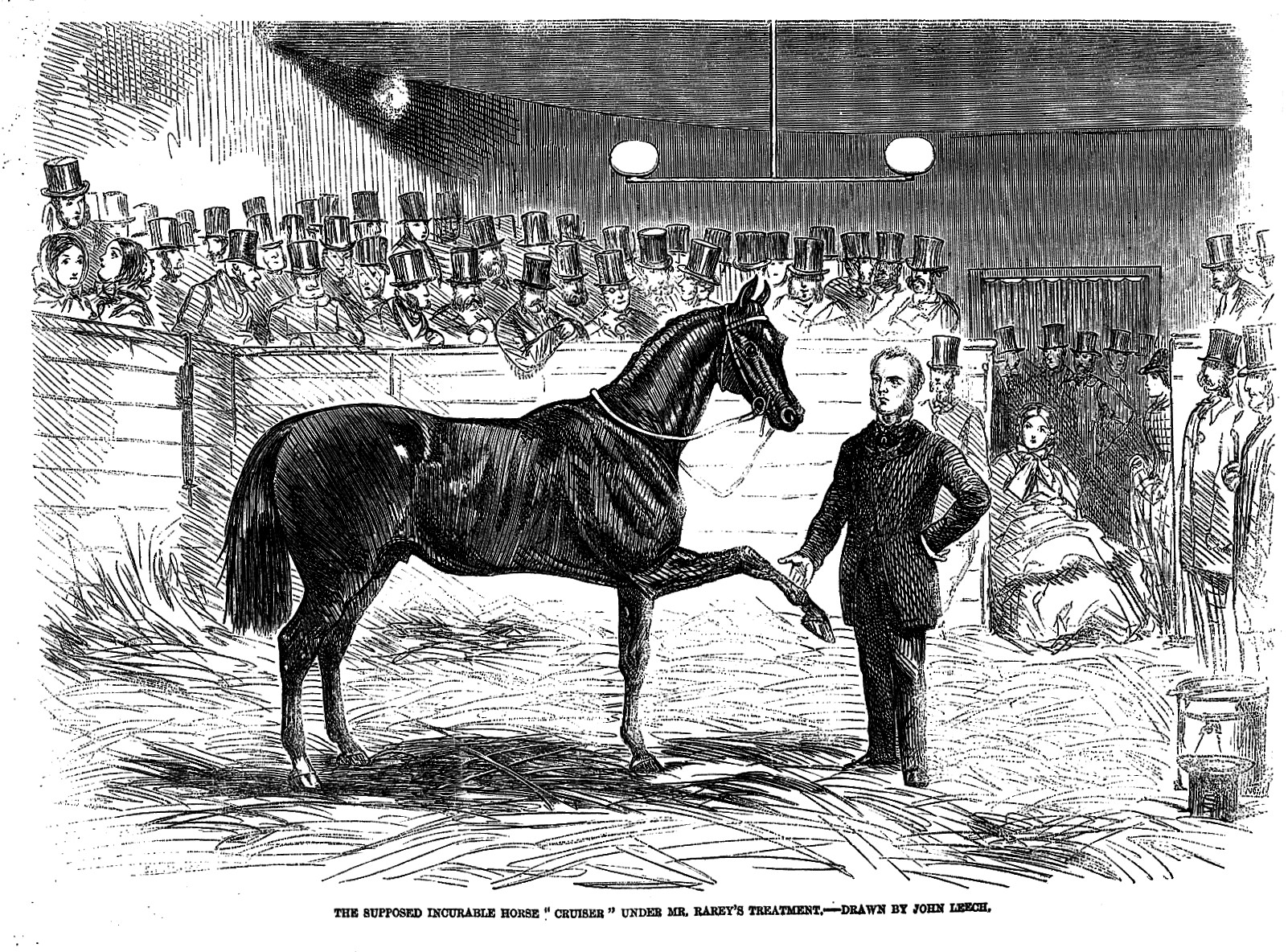
The pair traveled to Paris, Saudi Arabia, Coventry, Antrim and Dundee putting on shows for spellbound audiences. Looking for similar transformations, owners presented Rarey with rearing Clydesdales, biting Hackneys and bucking saddle ponies. At one point, Rarey was even asked to reform a problematic zebra.
At first, Rarey considered his training techniques a trade secret. He even sold a book that swore readers to secrecy. But as time went on, he adopted a more open approach, insisting that anyone could learn his methods.
A typical performance
A performance in Edinburgh was typical. The trainer was presented with a nervous Arabian, a bay colt that had only been haltered and an elderly horse who required a twitch and three people just to be bridled. Rarey gentled all three.
“He seems by instinct to know the temper and ‘mind’ of the animal he is called to deal with, and he appeals, as it were, to its intelligence to say who shall be master. . .[his system] commended itself to the good feelings of all by its perfect humanity,” wrote a reporter. Rarey spoke quietly, and when he first met a horse, kept one hand extended “in the most conciliatory manner,” according to another account. “Don’t thump a horse in praise,” he said. Instead, use pats as light “as a lady would give a canary bird.”
Other reporters describe a technique familiar to modern horse handlers: Rarey showed audiences how to cure “jibbing and buck-jumping” (jigging and bucking), by turning the horse in a circle.
In 1860, Rarey was taming a wild horse named Idle Boy, who “screamed” and “plunged” so much that “one or two anxious ladies” left. But Rarey was able to calm him, saddle him and remove his muzzle. In the same performance, he tamed a mare who kicked so hard and frequently that she had scarred her hind legs. In St. Petersburg, Russia, Rarey tamed a horse that had wrecked his stall and killed his groom.
There were some long nights, but Rarey never gave up on a horse.
An untimely end
When the Civil War broke out, Rarey enlisted in the Union Army, evaluating horses for Major General Henry Halleck. Rarey also did what he could to ease the impact of the “exigencies of war” on army horses. “Every man who is permitted to ride a horse,” Rarey said, “should be compelled by duty, if he has not the humanity and moral principle, to see that the horse has every care in his power to give.”
Eight months after the war’s end, Rarey had a stroke. As he recuperated, he was joined by his niece in traveling the country, hoping the stimulation would help him heal. Then one day in October 1866 on a visit to Cleveland, Ohio, Rarey set out for a walk but came straight home, saying his head hurt. An hour and 20 minutes later, he was dead at age 38.
Rarey’s will allocated resources for Cruiser’s care. In 1869, a reporter found a woman named Mrs. Jones tending the stallion. Cruiser lived in a field with Shetland ponies and came when Mrs. Jones called, the reporter wrote. But some said that after Rarey died, the stallion reverted to his old, wild ways. When Cruiser died in 1875, The New York Times ran an obituary, then as now an honor limited to those seen as having had a significant impact on the world.
“A new leaf in civilization”
Rarey’s methods are the foundation of his legacy. But his influence extended well beyond horsemanship. Anti-flogging activists pointed out that Rarey was more humane and mature than most schoolmasters.
“When I saw [Rarey’s] performance, I could not help thinking it was a sort of Aesop’s fable,” wrote Ralph Waldo Emerson, one of the mid-19th century’s leading chroniclers and philosophers. “He has turned a new leaf in civilization.”
Rarey “founded the gospel of kindness and reason in handling horses,” according to a 1906 retrospective. More than a century later, echoes of his ground-breaking work can be seen in the natural horsemanship movement, the recognition and celebration of modern horse whisperers and in the general acceptance of the idea that kindness, understanding and communication are essential to successful horse training.
Rarey’s compassion made horses vehicles of human transformation. By gentling horses, he allowed people to be gentled by them. As an Ohio historian put it in 1925, Rarey taught a crucial lesson for anyone working with horses: “Kindness is power.”